Origins
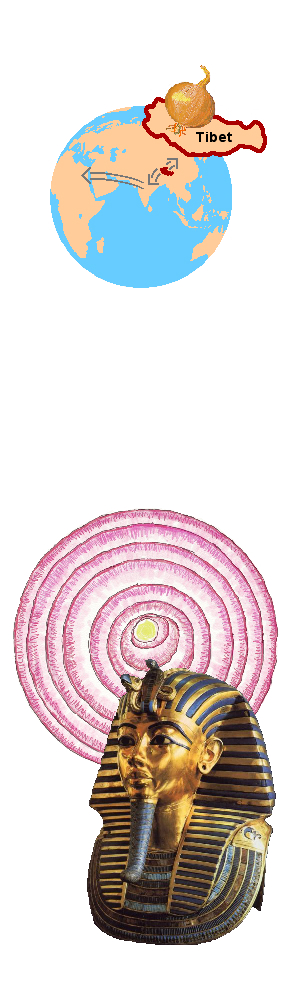
Onions are, in truth, a world vegetable. Over 300 different species of wild onions have been found in lots of different places around the world, on most every continent. But the large, bulbous onion — the one the size of a baseball that's widely used in the cooking of many cultures — is believed to have gotten its start in a single place. That's in the high plateaus of the Himalaya mountains in what is now Tibet.
From Tibet, onions migrated at least 6,000 years ago northwards into China and southwards into India. From India they quickly made their way to Egypt, where they became one of that country's most loved vegetables.
Can a vegetable be divine ?
The ancient Egyptians did love onions, or (more precisely) they revered them. According to historians working for the U.S. National Onion Association, the ancient Egyptians did consider onions to be divine. The Egyptians saw the onions' circular form, with layers within layers within layers, as a symbol of eternity and eternal life. For the Egyptians, onions became "an object of worship."
Onions were portrayed in sculptures in ancient Egypt. They were carved on monuments. They were depicted in the wall paintings that adorned the pharaohs' tombs deep within the Great Pyraminds. Onions were buried with most all Egyptian nobility, to accompany them on their spiritual journies into the after-life. When the tomb of Tutankhamen was discovered and opened less than 100 years ago, 3,000-year-old onions were discovered buried with him.